Twelve leads.
Ten seconds.
A call you have to make.
ECG Pro is where you learn to make it.
ECG Pro is an iOS 12-lead ECG casebook for medical students, doctors, paramedics and nurses. It contains 1,389 real cases with cardiologist interpretations, a 12-question placement test that measures your level, and guided practice matched to that measured level. The app is free to download, with full access by subscription or one-time purchase.
Textbooks teach the clean version of every pattern.
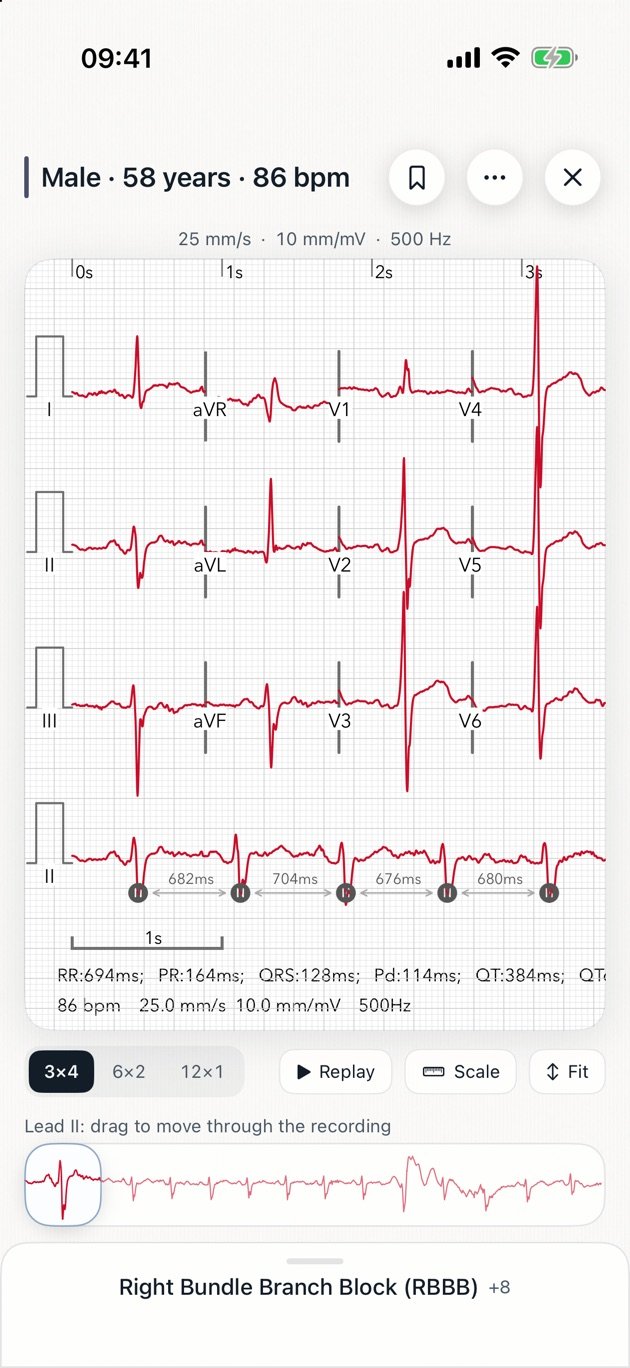
The tracing in the chapter has a textbook Wenckebach on it. The one in your hand has baseline wander, an ectopic in the middle of the strip, and a patient waiting on the other side of the curtain. Recognising a pattern you have been shown is not the same skill as working out what you are looking at.
ECG Pro is built from real recordings, with the interpretation a cardiologist actually gave — including the ones that are genuinely hard to call. You practise on the messy version, because that is the one you will meet.
A three-minute test, then a casebook that fits.
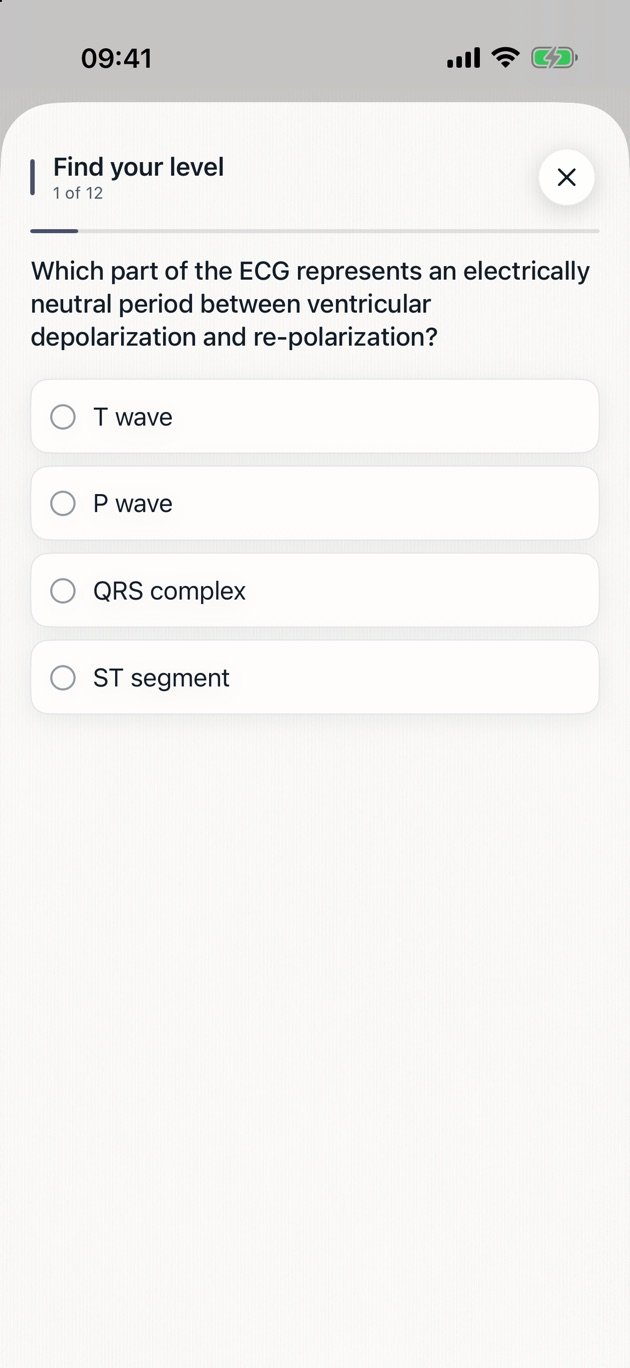
A list of a thousand cases is not a study route. Nobody reads it, and there is no reason to start at case one. So ECG Pro asks twelve questions — drawn evenly across four bands of difficulty, about three minutes — and places you. From then on the daily cases come from your band.
| Band | What it covers | Cases |
|---|---|---|
| Foundations | Normal tracings and sinus rhythms | 148 |
| Common Patterns | AF, ectopy, first-degree block, axis, bundle branch block, hypertrophy, ST-T | 710 |
| Systematic Reads | Higher-degree blocks, pre-excitation, infarct territories, wide-complex rhythms | 399 |
| Advanced | Torsades, R-on-T, alternans, the subtle and uncommon | 132 |
The test is free, always, and you can retake it whenever you want. A retake can change the mix of cases you are served, but the level you have reached is never taken away from you.
Not the answer. The route to the answer.
Showing you a hard case and then printing the verdict teaches nothing. ECG Pro walks the sequence a cardiologist reads in, and asks you to commit at each step before it moves on.
Rate and rhythm are marked. The rest are taught, not scored — because those are the two steps the cardiologist reads cover reliably enough to grade against. Marking a step the data cannot support would mean inventing a verdict, and a teaching app does not get to do that. The numbers behind that decision are in the FAQ.
Get a step wrong and ECG Pro can send you to another case at the same difficulty that exercises the same step — another rep of the thing you missed, not a harder version of it.
Counted, not claimed.
Every figure below is the actual contents of the app.
Those six case lines total 1,389, of which 1,336 are ECG recordings — the rest are the rhythm videos and the murmur cases. The quiz bank sits on top, and so do more than fifty written explanations, one per named finding.
Paediatric cases are drawn by age from the adult library; neonates are kept separate, because right-axis dominance and a rate near 150 are normal at a few days old and wrong everywhere else.
Six ways in, and two ways to work.
Daily cases
Today's case plus the previous thirteen, from your band. Everyone on the same track gets the same case.
By finding
Choose the thing you are revising — AF, Wenckebach, LVH — and get its explanation, its video, and its cases. All 48 findings →
By ECG pattern
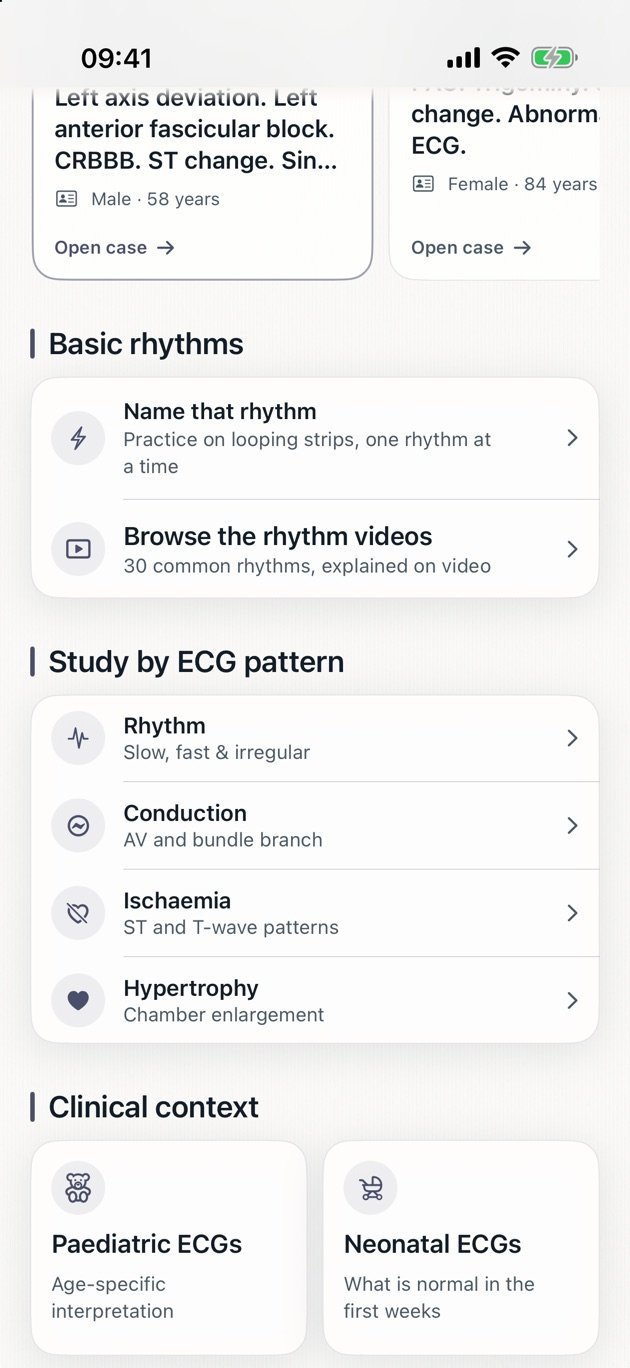
Rhythm, conduction, ischaemia, hypertrophy. The classic teaching buckets.
By clinical context
Paediatric, neonatal, pregnancy and normal variants, each kept as its own reading problem.
Basic rhythms
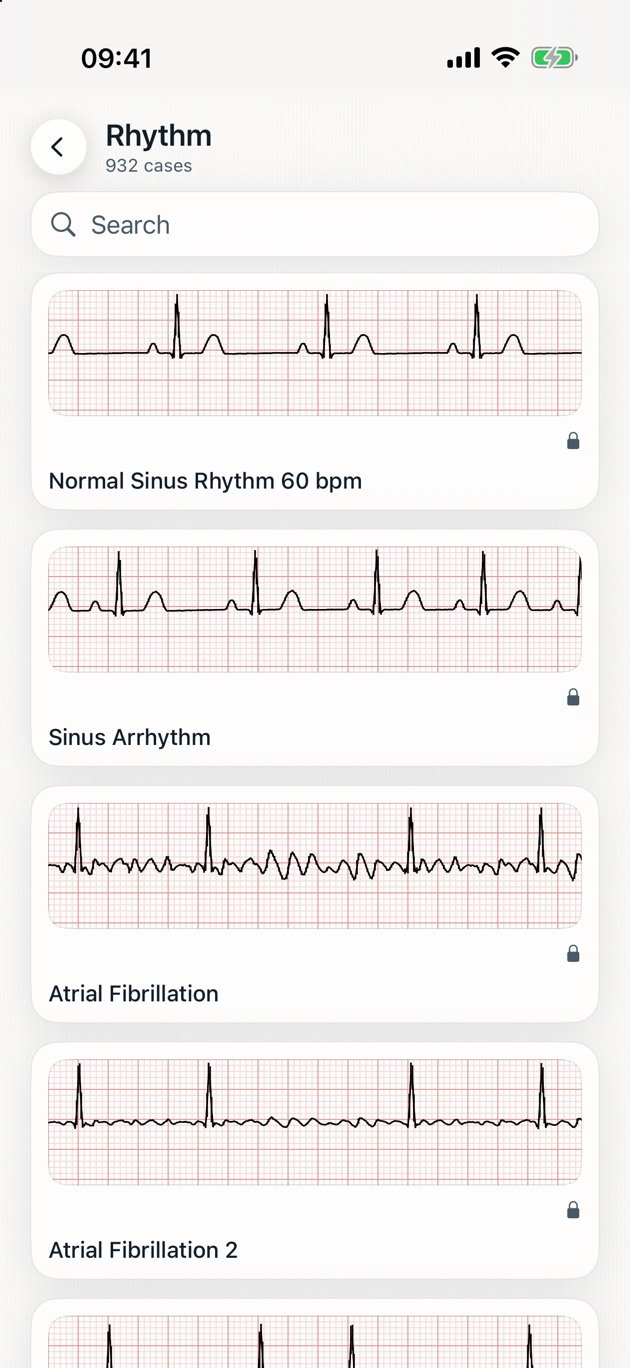
Thirty rhythms on video, ordered from everyday to rare, plus a name-that-rhythm drill on looping strips.
Challenging cases
Tracings carrying three or more findings at once — the ones that stay difficult with experience.
Practice, or Test
In Practice the cardiologist's interpretation is visible: read the tracing, then check yourself against the report and the explanation behind each finding. In Test it is hidden until you commit to a read — and committing is what counts toward re-testing your level, because opening a case demonstrates nothing.
On the tracing
Standard 3×4 sheet, 6×2, or all twelve leads stacked and scrolling. Calibration and paper speed always stated. Beat annotations and RR intervals on the rhythm strip, with PR, QRS, QT and QTc measured off the recording. Drag the paper to move through the ten seconds, or hit Replay and watch it come out live. There is also a monitor mode — the tracing sweeping across the screen in real time — for the paramedics and ED staff who read rhythms that way in the first place.
Anyone who has to call a tracing.
In their own words
"Best ECG app"
Everything you need is here. From neonates to elderly. From normal to rare. No need to look anywhere else.
🇺🇸 iTatox · United States · 21 Jul 2018
"Amazing"
This is by far the best EKG training app available. The amount of cases, the simplicity of the presentation and the amount of resources located within this one app make it invaluable as a learning tool.
🇺🇸 SoberinJeffersonDistrict · United States · 26 Jun 2018
In training
"Couldn't have anything better"
I am currently in an EKG class and this has been a lifesaver. It helps you get such a better understanding of the rhythms and helps pinpoint what you need to look for.
🇺🇸 Stonedsloth19 · United States · 9 Apr 2021
"Great app"
If you need to understand more prior to becoming a paramedic, get this app. As an EMT you will be eons ahead of your peers and will begin to step into the realm of paramedicine.
🇺🇸 IBus11 · United States · EMT · 1 Apr 2020
On the ward, and teaching with it
"Excellent!"
Great tool. I use it everyday in the ED.
🇺🇸 Charlieneck · United States · 22 Jul 2018
"Teaching tool"
Great for teaching students and quizzing residents.
🇺🇸 kgkinkade · United States · 17 Jul 2018
Frequently asked questions
Who is ECG Pro for?
Medical students and junior doctors building interpretation skill, paramedics and EMTs who read rhythms under time pressure, and nurses who want to be confident about what they are looking at. The app assumes you are learning to read ECGs, not that you already can.
Are the ECGs real recordings?
Yes. Every case is a real recording with a cardiologist's interpretation attached, including the awkward ones. Textbook tracings show the clean version of each pattern; real ones are noisier, and learning to call those is the point.
How does ECG Pro know what level I am at?
A 12-question rhythm test, about three minutes, drawn evenly across the four bands. It places you in a band and the casebook then serves cases from it. The test is free, always, and you can retake it whenever you want — a retake can change the mix of cases, but never takes a level away from you.
Which steps of the read does ECG Pro actually mark?
Rate and rhythm. Those are the two the cardiologist reads cover reliably: a rate is recorded on every case in the library, and a rhythm on 93% of them, so both can be graded against the original read.
Axis appears in only about a third of reads — and a read that says nothing about axis is not evidence of a normal one. Intervals are recorded on fewer than a fifth. Morphology and ST-T sit around half. Those steps are taught, with guidance on what to look at, but not scored.
The alternative would be to guess and present the guess as a verdict. Marking fewer steps honestly is worth more than marking all seven badly.
What is free and what is paid?
The app is free to download. The placement test is free and always will be, a daily case is free every day, and a small number of cases in each list are free to open.
Full access to the casebook is a monthly or yearly subscription, or a one-time lifetime purchase. Family Sharing is available on the yearly and lifetime options.
Does ECG Pro cover paediatric and neonatal ECGs?
Yes, and they are kept apart on purpose. Neonatal ECGs have their own section because they are a different reading problem: right-axis dominance and a rate near 150 are normal in the first weeks and abnormal in a child. Pregnancy cases and normal-variant recordings have their own sections too.
Is ECG Pro a medical device?
No. ECG Pro is an educational app for clinicians and students. It is not a medical device and is not intended for diagnosis or treatment decisions.
Real ECGs are sometimes genuinely ambiguous, and an interpretation shown here reflects one reasonable reading of that tracing, not a definitive diagnosis of the patient it came from. Measurements, including intervals and beat annotations, are produced by automated analysis of the stored recording. Always assess a patient with the full clinical picture, and seek senior review where it matters.
What languages does ECG Pro support?
English, German, Italian, Japanese, Simplified Chinese and Traditional Chinese.
The tracing will not wait
for you to look it up.
1,389 real cases, a level that was measured rather than guessed, and a read you are walked through rather than shown.
Download on the App Store