Long QT Syndrome (LQTS) on the ECG
Long QT syndrome is prolongation of the corrected QT interval beyond 450 milliseconds in men or 460 milliseconds in women, reflecting delayed ventricular repolarisation and carrying a risk of torsades de pointes.
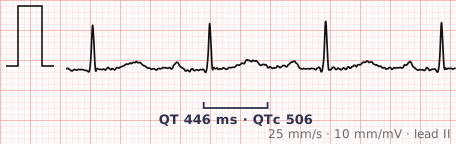
ECG criteria
| Feature | What you see in LQTS |
|---|---|
| QTc threshold | > 450 ms in men, > 460 ms in women. Above 500 ms carries markedly increased risk. |
| Measurement | Measure QT from the start of the QRS to the end of the T wave, then correct for rate. |
| Correction | Bazett: QTc = QT ÷ √RR. Simple but over-corrects at fast rates and under-corrects at slow ones. |
| Best lead | Use lead II or V5, and take the longest clearly measurable QT. |
| T wave shape | Often broad, notched or biphasic. Genotype influences morphology. |
| U waves | Prominent U waves may merge with the T and cause over-measurement. |
How to spot it
- Choose a lead with a clearly defined T wave end — usually lead II or V5.
- Measure from the start of the QRS to the end of the T wave. Use the tangent method: draw a tangent down the steepest part of the T wave descent and take where it crosses the baseline.
- Exclude the U wave. Including it is the most common source of a falsely long measurement.
- Correct for rate. Bazett is standard, but be aware it over-corrects above 100 bpm and under-corrects below 60.
- Compare against 450 ms for men and 460 ms for women, and note that above 500 ms the risk rises sharply.
- Then look for a cause: check the drug chart, and check potassium, magnesium and calcium.
What it gets confused with
| Looks like | How to tell them apart |
|---|---|
| Prominent U wave | A U wave included in the measurement falsely lengthens the QT. Look for a separate deflection after the T. |
| Hypokalaemia | Flattened T waves with prominent U waves and ST depression — often reported as a long QT when it is really a long QU. |
| Hypocalcaemia | Prolonged ST segment with a normal-width T wave — a genuinely long QT of a distinctive shape. |
| Drug effect | Many antiarrhythmics, antipsychotics, antidepressants, antibiotics and antiemetics prolong the QT. |
| Bundle branch block | The wide QRS lengthens the QT mechanically; the JT interval is more useful here. |
| Raised intracranial pressure | Deep widespread T inversion with a long QT. |
Traps
- The U wave is the classic measurement trap. Including it turns a normal QT into an apparently dangerous one. Use the tangent method and stop at the end of the T wave.
- Bazett's formula is unreliable at extremes of rate — it over-corrects above 100 bpm, which manufactures long QTc values in tachycardic patients, and under-corrects below 60.
- Multiple QT-prolonging drugs together are far more dangerous than any one alone, and electrolyte disturbance multiplies the effect.
- Hypokalaemia and hypomagnesaemia both prolong repolarisation and both are correctable — check them before anything else.
- A congenital long QT may be intermittent, so a single normal ECG does not exclude it in someone with syncope or a family history of sudden death.
- In bundle branch block the QRS itself lengthens the QT, so conventional thresholds do not apply.
Why it happens
The QT interval spans ventricular depolarisation and repolarisation. Delayed repolarisation — from ion channel mutations in the congenital forms, from drugs blocking potassium channels, or from low potassium, magnesium or calcium — lengthens the interval and widens the window during which part of the ventricle has recovered while another part has not. An ectopic beat landing in that window can trigger re-entry, which is torsades de pointes.
Why it matters
The importance of a long QT is entirely about what it can precipitate. Torsades de pointes is a polymorphic ventricular tachycardia that may terminate spontaneously or degenerate into ventricular fibrillation. Because so many common drugs prolong the QT and so many causes are correctable, measuring it properly is one of the highest-yield habits in ECG interpretation.
Questions
What QTc value is considered prolonged?
Above 450 milliseconds in men and 460 milliseconds in women. A QTc above 500 milliseconds is associated with a markedly increased risk of torsades de pointes.
How do I measure the QT interval correctly?
Use lead II or V5, measure from the start of the QRS to the end of the T wave using the tangent method — a tangent along the steepest part of the T wave descent, taken to where it crosses the baseline — and exclude any U wave. Then correct for heart rate.
Why can Bazett's formula be misleading?
It over-corrects at fast heart rates, producing falsely prolonged QTc values in tachycardic patients, and under-corrects at slow rates. Alternative formulae such as Fridericia perform better at extremes of rate.
What causes a prolonged QT interval?
Congenital ion channel mutations, a wide range of drugs including antiarrhythmics, antipsychotics, antidepressants, macrolide and quinolone antibiotics, and electrolyte disturbances — particularly low potassium, magnesium and calcium.
What is torsades de pointes?
A polymorphic ventricular tachycardia occurring on a background of a prolonged QT interval, in which the QRS complexes appear to twist around the baseline. It may self-terminate or degenerate into ventricular fibrillation, and is treated with magnesium.
References
Reading about long qt syndrome is not the same as calling it on a tracing you have never seen.
Practise on real cases in ECG Pro