Sinus Tachycardia on the ECG
Sinus tachycardia is sinus rhythm at a rate above 100 beats per minute, with a normal upright P wave in lead II preceding every QRS complex.
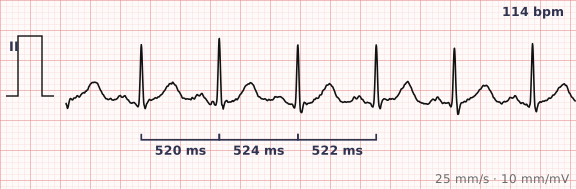
ECG criteria
| Feature | What you see in Sinus Tachycardia |
|---|---|
| Rate | Over 100 bpm. Usually 100–150 in adults; rarely above 180 except with exertion or in children. |
| Rhythm | Regular, though it speeds up and slows down gradually rather than switching abruptly. |
| P wave | Normal sinus P before every QRS — upright in II, inverted in aVR. May be hidden in the preceding T wave at fast rates. |
| PR interval | 120–200 ms, constant. May shorten slightly as rate rises. |
| QRS | Narrow, under 120 ms, unless there is pre-existing bundle branch block or rate-related aberrancy. |
| ST-T | Often mild ST depression and T flattening at high rates. This is rate-related and not by itself ischaemia. |
How to spot it
- Confirm the rate is over 100 — count QRS complexes across the 10-second strip and multiply by six, or divide 300 by the number of large squares between beats.
- Find a P wave before every QRS. At rates above about 140 the P hides in the preceding T wave: look for a T wave that has changed shape compared with a slower part of the strip.
- Check the P is upright in lead II. Upright means sinus; inverted or absent points somewhere else.
- Confirm the rhythm is regular but not rigidly so. Sinus tachycardia drifts; re-entrant tachycardias are metronomic.
- Then stop looking at the heart and ask why. Sinus tachycardia is a response, so the diagnosis is usually not on the ECG.
What it gets confused with
| Looks like | How to tell them apart |
|---|---|
| Atrial flutter with 2:1 block | Flutter at 150 is the classic mimic. Look for flutter waves in II, III, aVF and V1 — a sawtooth baseline rather than a flat one. |
| Supraventricular tachycardia | SVT starts and stops abruptly, sits at a fixed rate (often 150–250), and has no visible sinus P wave. |
| Atrial fibrillation with rapid response | Irregularly irregular. Sinus tachycardia is regular. |
| Ventricular tachycardia | Wide QRS. Sinus tachycardia is narrow unless there is a pre-existing block. |
Traps
- A regular narrow-complex tachycardia at exactly 150 is atrial flutter until proven otherwise. The atrial rate in flutter is about 300, and 2:1 conduction gives 150. Sinus tachycardia can sit at 150 too, so find the P waves before deciding.
- The ST depression that comes with a fast rate is frequently over-called as ischaemia. Judge the ST segment again once the rate has settled.
- Sinus tachycardia is a symptom, not a diagnosis. Fever, pain, hypovolaemia, anaemia, hypoxia, anxiety, thyrotoxicosis, pulmonary embolism and drugs all produce it.
- Treating the rate directly is usually wrong. A patient who is tachycardic because they are bleeding needs the bleeding stopped, not the rate slowed.
Why it happens
Sympathetic drive and circulating catecholamines increase the rate of spontaneous depolarisation in the sinus node, while vagal withdrawal removes the brake. The conduction pathway is entirely normal — only the firing rate changes, which is why the complexes look ordinary.
Why it matters
Sinus tachycardia is nearly always secondary, so its value is as a pointer. It is one of the few ECG findings whose main job is to send you back to the patient, and a persistent unexplained sinus tachycardia in an unwell patient is a warning that should not be dismissed.
Questions
What is the highest rate sinus tachycardia can reach?
Roughly 220 minus the patient's age in years is a common ceiling for maximal sinus rate. In practice a resting adult above about 180 is more likely to have a re-entrant tachycardia than sinus tachycardia.
Why can I not see P waves if it is sinus?
At fast rates the P wave falls on the preceding T wave and merges with it. Compare the T wave shape with a slower portion of the strip — a "notched" or unusually peaked T often contains the hidden P.
Is sinus tachycardia dangerous?
The rhythm itself is normal conduction running fast. What matters is the cause, which ranges from exercise or anxiety to haemorrhage, sepsis or pulmonary embolism.
Reading about sinus tachycardia is not the same as calling it on a tracing you have never seen.
Practise on real cases in ECG Pro