Intraventricular Conduction Delay (IVCD) on the ECG
Intraventricular conduction delay is a QRS duration of 110 milliseconds or more that does not meet the morphological criteria for either right or left bundle branch block, indicating slowed conduction through ventricular myocardium without a discrete fascicular pattern.
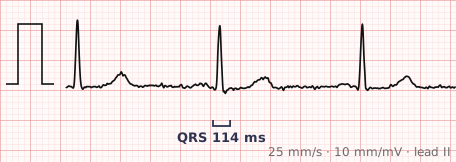
ECG criteria
| Feature | What you see in IVCD |
|---|---|
| QRS | 110 ms or more, often 120 ms or more. |
| Morphology | Neither an RSR' in V1 nor a broad monophasic R in V6. The shape does not match either bundle branch block. |
| V1 | No classic RBBB pattern. |
| V6 | No classic LBBB pattern; septal Q waves may be preserved. |
| Axis | Variable. |
| ST-T | Often non-specific secondary changes. |
How to spot it
- Measure the QRS and confirm it is genuinely prolonged in more than one lead.
- Check V1 for an RSR'. If present, this is RBBB rather than IVCD.
- Check V6 and lead I for a broad monophasic R. If present, this is LBBB.
- If neither pattern fits, IVCD is the correct description — it is a diagnosis of exclusion.
- Then look for a cause: hyperkalaemia, sodium channel blocking drugs, cardiomyopathy, or extensive scar. IVCD is a finding that asks a question.
What it gets confused with
| Looks like | How to tell them apart |
|---|---|
| Right bundle branch block | RSR' in V1 with a broad S in I and V6. |
| Left bundle branch block | Broad notched R in V6 and I, deep S or QS in V1. |
| Hyperkalaemia | Progressive widening in all leads with peaked T waves and flattening or loss of P waves. A metabolic emergency. |
| Ventricular pacing | Pacing spikes precede each complex. |
| WPW | Short PR with a delta wave slurring the QRS upstroke. |
| Ventricular rhythm | No preceding P waves; wide complexes arising from the ventricle itself. |
Traps
- IVCD is a description, not a diagnosis. It says the QRS is wide and the pattern is not typical, which should prompt a search for a cause rather than end the analysis.
- Hyperkalaemia is the cause not to miss. Diffuse QRS widening with peaked T waves and small or absent P waves needs urgent potassium measurement.
- Sodium channel blocking drugs — tricyclics, flecainide, and others in overdose — widen the QRS in the same non-specific way.
- A wide QRS from any cause reduces the reliability of hypertrophy criteria and axis interpretation.
- Measure the QRS in the lead where it is widest. Reading a single lead systematically under-measures duration.
Why it happens
Conduction slows through ventricular myocardium without a discrete block of one bundle branch. This may reflect diffuse fibrosis or scar, myocardial disease, drug effects on sodium channels, or electrolyte disturbance affecting membrane conduction. Because there is no single anatomical block, the activation sequence is disordered rather than following a predictable alternative route, so no characteristic morphology emerges.
Why it matters
Intraventricular conduction delay is associated with underlying myocardial disease and is a marker of worse outcomes in heart failure populations. Its immediate value at the bedside is as a prompt: a newly wide QRS that fits neither bundle branch pattern should send you looking for hyperkalaemia or drug toxicity before anything else.
Questions
What is a non-specific intraventricular conduction delay?
A QRS duration of 110 milliseconds or more that does not match the morphology of either right or left bundle branch block. It indicates slowed conduction through ventricular muscle without a discrete fascicular block.
What causes IVCD?
Diffuse myocardial disease or scar, cardiomyopathy, hyperkalaemia, and drugs that block cardiac sodium channels such as tricyclic antidepressants and flecainide, particularly in overdose.
Is IVCD serious?
It has no significance on its own, but it points to underlying myocardial disease or a metabolic or toxic cause. A new IVCD should always prompt a check of potassium and a review of medication.
References
Reading about intraventricular conduction delay is not the same as calling it on a tracing you have never seen.
Practise on real cases in ECG Pro